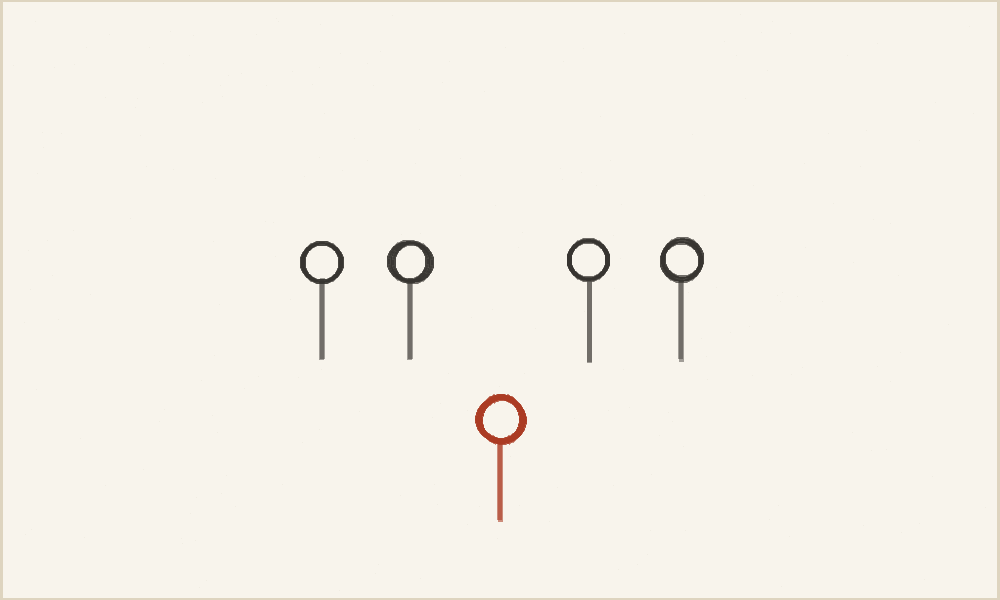
It seems like it should work the opposite way: more witnesses to an emergency should mean more help, not less. Yet one of social psychology’s most replicated findings shows the reverse — as the number of bystanders increases, the likelihood that any single person intervenes tends to decrease.
Where this research began
The bystander effect became a major focus of social psychology research following a widely publicized 1964 case, which prompted psychologists John Darley and Bibb Latané to investigate why witnesses to an emergency often fail to help. Their subsequent laboratory studies found a consistent pattern: participants who believed they were the only witness to a staged emergency responded quickly and reliably, while participants who believed multiple other witnesses were also present responded more slowly, or sometimes not at all.
Diffusion of responsibility
The primary explanation researchers settled on is diffusion of responsibility: when multiple people are present, the sense of personal obligation to act gets psychologically distributed across the group, so each individual feels less personally responsible than they would if they were alone. No single person consciously decides not to help; rather, the felt weight of ‘someone should do something’ quietly becomes ‘someone else will probably do something,’ and that shift happens largely outside conscious awareness.
Pluralistic ignorance and reading the room
A second contributing mechanism is what psychologists call pluralistic ignorance: in an ambiguous situation, people often look to others’ reactions to decide how to interpret what’s happening, and if everyone else appears calm, each individual may conclude the situation is less serious than it actually is, even though everyone is privately uncertain and simply mirroring the outward calm of those around them. This can create a strange collective paralysis where an entire group underreacts to something that any single observer, alone, would have recognized as urgent.
Evaluation apprehension
A third factor researchers identify is evaluation apprehension — a hesitation to act stemming from fear of being judged by onlookers if the intervention turns out to be unnecessary or is handled poorly. In front of a crowd, the social risk of a misjudged response can feel more immediately salient than the risk to the person who may actually need help, especially in ambiguous situations where it isn’t instantly clear whether intervention is genuinely warranted.
What actually helps counter the effect
- If you need help in a crowd, research consistently supports singling out one specific person directly — by appearance or location — rather than addressing the group generally, which interrupts diffusion of responsibility.
- If you witness a potential emergency, naming it explicitly out loud (‘this looks like an emergency, someone should call for help’) can help break pluralistic ignorance for the whole group, not just yourself.
- Being aware of the bystander effect itself has been shown in some studies to meaningfully increase a person’s own likelihood of intervening, since conscious awareness of the pattern can counteract its largely automatic pull.
A sobering, and genuinely useful, finding
The bystander effect isn’t a comfortable finding, since it suggests that ordinary, decent people can fail to help purely due to the presence of others, independent of their actual character or values. But understanding the mechanism precisely is also what makes it possible to counteract — both by knowing how to direct a request for help more effectively, and by recognizing the pull toward inaction clearly enough to override it when it matters.
Does the effect hold in digital spaces too
Researchers have increasingly examined whether a version of the bystander effect operates online, where someone posting about a crisis to a large group chat or social feed may experience a similar diffusion of responsibility as a crowd witnessing an emergency in person. Some studies on online bystander behavior have found broadly similar patterns, with larger visible audiences associated with slower or less frequent individual responses, suggesting the underlying psychological mechanism isn’t limited to physical proximity, but extends to any context where a person’s sense of individual responsibility can be diluted by an awareness of many other potential helpers.